
Developer: Defiant Development
Publisher: Defiant Development
Rrp: £18.99
Released: 17th Feburary 2015
Available on Steam and Gog.com
Played using: A Xbox 360 control pad
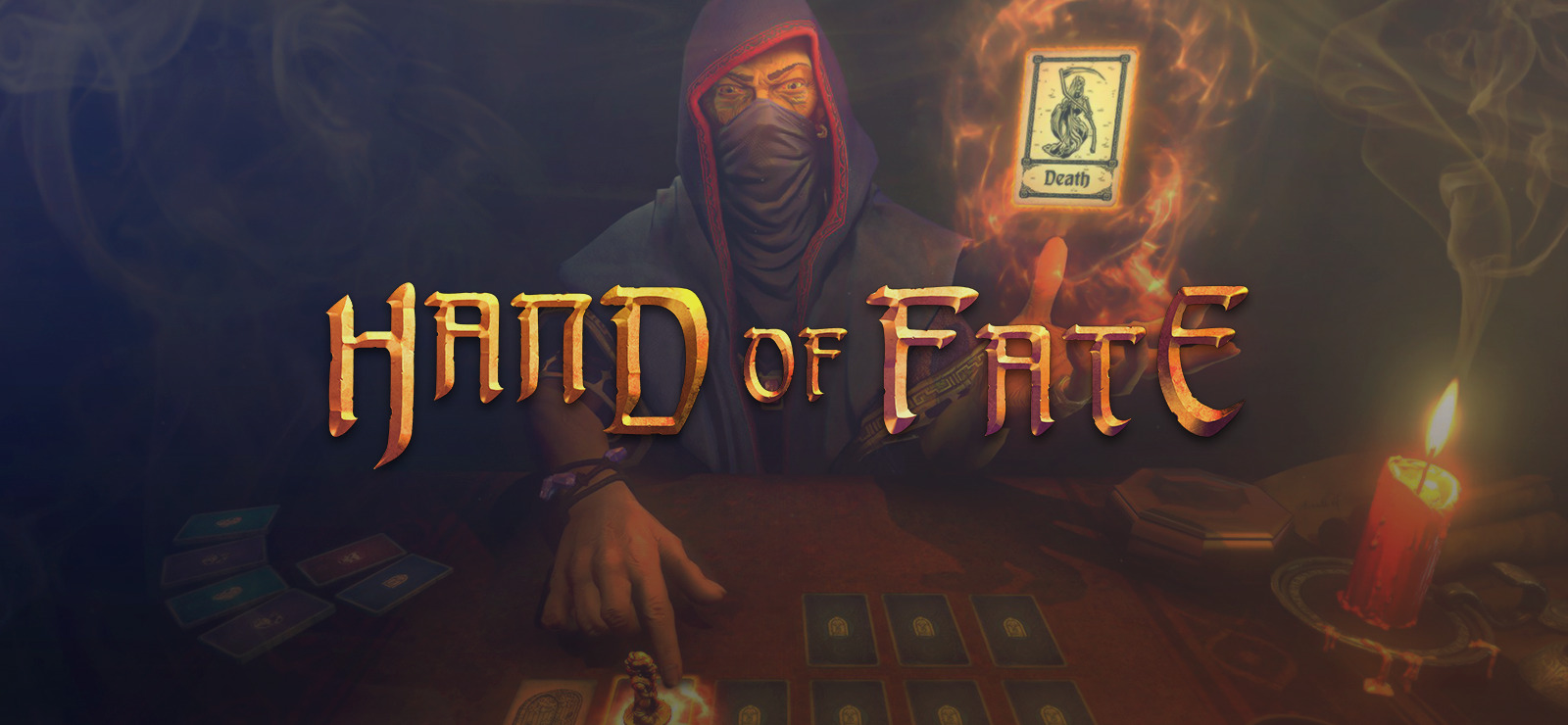
The mysterious dealer floats the cards in front of you, each one representing an aspect of your fate. He begins to shuffle the deck before you and you can’t help but wonder ‘can I survive his machinations’?
Something that I think is interesting to note is that Hand of Fate was crowdfunded through Kickstarter and has been available to play on Early Access for a while. Thankfully though, the developers of this game didn’t wallow in Early Access forever (like so many others) and it has recently come out as a full release.
Hand of Fate is a hard one to put in a genre, it’s a real oddity being part roguelite (a phrase coined by Total Biscuit), part choose your own adventure, part arena brawler and part game of chance. The dealer puts a series of cards on the table and places a statue on the first of them. The statue is you, or rather a representation of you, and each card that the statue lands on is an event. These events come in a number of different flavours, some are purely text based and allow you to make a choice, while some others will launch you into a arena to fight.
Somewhere within each series of laid cards are the ‘Stairs’ this is one of two end goals that you must reach. The other end goal is one of the dealers champions that must be defeated for you to progress.

After you have been through the tutorial mode (which is automatically started when you first play) you will be able to see that there are two modes to play, story and endless. However endless mode remains locked until you have defeated a certain enemy.
Story mode sends you to the cabinet, it is here you can choose which final boss you will struggle against. At first there isn’t really a choice, unless you want to fight a previous encounter. Once you’ve chosen your opponent you are granted the ability to build your deck. It is here that you can use those cards you unlocked to seed the deck to be more in your favour, perhaps including more equipment cards to try an ensure a fighting chance, or maybe you feel like making life difficult for yourself. If you wanted to you could put lots of non-combat cards in and gain boons that way. There is a catch though, if you’ve not encountered the cards you have included before you won’t know what they actually do, they could be good or bad.
Actually there are some other catches, you see, as you unlock cards so does the dealer as well as ramping up the difficulty. He also gets to add his own cards to the deck you have so carefully constructed to land in your favour.
Each session of play is split into three parts. The first part there is the deck building screen, it’s here that you can inspect each card and seed the deck with them to attempt to make your life easier. Helpfully all the button prompts are clearly indicated along the bottom of the screen.
The second part, and the one you will spend the majority of your time in, is the tabletop view. In this view you can see the cards as they are laid in the table in front of you. It is in the view that you move your token on to a card. Each card has its own effects, some will help, some will hinder and others still will do either dependant on the choices you make. The controls here are simple, the left analogue stick highlights the card you wish to move to and the [A] button confirms the selection and anymore confirmations you have to make. If you press the [back] you can view you inventory where you can swap around equipment.
Lastly there is the combat view, this only occurs when you chance upon a combat encounter (which is fairly common) or fight the final boss of the card set. Once again the controls are quite simple and easy to understand. Movement is done with the left analogue stick, [X] performs a attack, [A] is a dodge roll, [Y] counters (but only if you have a shield and time it correctly), [B] is a shield bash or if you don’t have a shield performs a kick. If you’ve been fortunate enough to collect a weapon with a power that is activated using the left bumper. The right bumper is used only if you have a artefact, these are limited use items but can turn the tide of a battle.
The combat is done in the style of Batman Arkham Asylum, and while not quite as on the mark as the Assassins Creed or Arkham series it is still very serviceable. Then again it can hardly be expected to, the studios that developed the Batman Arkham series and Assassins Creed have the budget to afford mo-capping that indie dev’s like this one just don’t
The number of opponents you fight depends on the number on the cards themselves. So for example, you enter an arena fight and the four of Dust appears, this will means you’re facing four opponents.
Your health, food and gold is depicted on three cards at the bottom left side of the screen. The food is consumed as you move from card to card, if you run out then each move will take ten health, run out of health and its game over. Luckily there are a few ways to increase the amount of food you are carrying whether it’s through buying off of merchants (costing gold as you might expect) or through an event. Gold is usually gained through combat but can also be found through event cards too.
Occasionally you will encounter an event that will give you a token, these token unlock more cards that you use to seed the deck. This card seeding allows you to customise the deck so that your attempts can perhaps be more successful.

As was mentioned earlier, death occurs when you run out of health, this can come from combat damage or simply running out of food and starving to death. Should that happen the tokens you have earned are toted up and unlocked and the game begins anew. Now, unlock most roguelite’s death in this game doesn’t remove all progress but instead sets you back to to the beginning of the current card set you were engaged in.
Graphically speaking Hand of Fate isn’t the most pretty thing to look at but its visuals more than get the job done. Think about it, for the most part you are looking at a table and cards… Not something that system intensive really, even if you include the dealer and his animations. But what graphics there are are aesthetically pleasing to me, the arenas are small but interesting and colourful.
It does suffer from some minor clipping issues but nothing particularly jarring, sometimes my characters shield would pass through and opponents face as we were fighting, otherwise it’s pretty flawless.
To be honest while I’ve been playing this game the graphics were one of the least important things to me. The dealers commentary, the text of the cards and the immersiveness of the play more than kept me invested.

As you play, the dealer will make comments, sometimes because of the decision you’ve made, cards you’ve picked or for inaction. While this is a relatively minor thing I found that it made the game very enjoyable to play. Hearing his accusatory comments about a card appearing regularly and being able to defeat his much vaunted opponents always leaves me with a grin. I just want to make a point of mentioning the voice acting on display for the dealer. He is voiced perfectly, not sounding cartoonish or maniacal which would have been very easy to do, in fact quite often he actually sound rather somber.
I had a lot of fun with this game, I won’t lie it can be incredibly frustrating and in some case downright unfair, but as the saying goes ‘that’s the luck of the draw’. Honestly I think this game is worth every penny of its Rrp, there’s quite a lot of replay value and it can be very challenging. Also if the developers were to create DLC later down the line they wouldn’t need to worry about interfering with the story as it would fit in without issue. At time of writing there isn’t a Steam Workshop, though they are looking into getting one started.


