Developer: Bioware
Publisher: Electronic Arts
Steam Deck Compatibility?: Playable
Rrp: £34.99 (Steam, Epic) and EA (Subscription model)
Released: 20th March 2017
Available on: Steam, Epic and EA
Played Using: Xbox One Control Pad
Approximate game length: 20+ Hours
I have a deep love for the Mass Effect series, and I don’t just mean the games. I read every comic, every book, even watched the (not good) animated movie and have played every game including the short lived app that was tied to Mass Effect 3. Well… I had played them all except this one, this was always on the backburner for me, until now.
Does it stack up against the main series? Honestly no, the fact that this game came out in 2017 and there hasn’t been a sequel or even any DLC’s (that aren’t multiplayer focused) should be telling.
So what happened? The answer is actually very simple and comes in two parts. The first part being that in the main game series you end up fighting and defeating a galaxy ending threat. Once you’ve done that you don’t have a choice you have to go even bigger. That is, unless you change the setting itself. But that comes with the problem of losing the fans who love the setting and characters you already have. It’s a tough sell. Then comes the second part, Bioware switched from the Unreal 3 engine to the Frostbite engine and it wasn’t an easy transition. The game ended up releasing with tons of bugs and animation errors that just ruined the experience. Sadly, even now after having been patched a number of times (which they have stopped doing) the game still has lots of bugs and animation errors. Most aren’t game breaking, but there are one or two that are.
Anyway, all of that combined has caused this game to be the pariah of the Mass Effect series. But here’s the thing, it’s actually not bad at all. It’s just not on par with the main games.
Mass Effect Andromeda is set between the events of Mass Effect 2 and 3, or at least that’s where the opening cutscene’s start. The game itself actually starts six hundred and forty three years later in the Andromeda Galaxy (thus the name), specifically in the Heleus Cluster. You are part of the Andromeda Initiative. Specifically you are a ‘Pathfinder’ who is tasked with finding a new home for humanity in the Andromeda galaxy.
You play as a character called Ryder, it’s actually their last name but it’s what everyone will call you aside from ‘Pathfinder’. You’ll get to pick whether you wish to play as a man or a woman and by default they’re named either Sara or Scott. Whichever you pick your opposite will become your twin in the game. There is the option to create a customised character where you will also have you create your twin.
I chose to play as the default Sara Ryder, partially because I preferred the female version of Shepard in the previous games but also because I feel I should go for what is supposed to be the default experience that most players will go for.
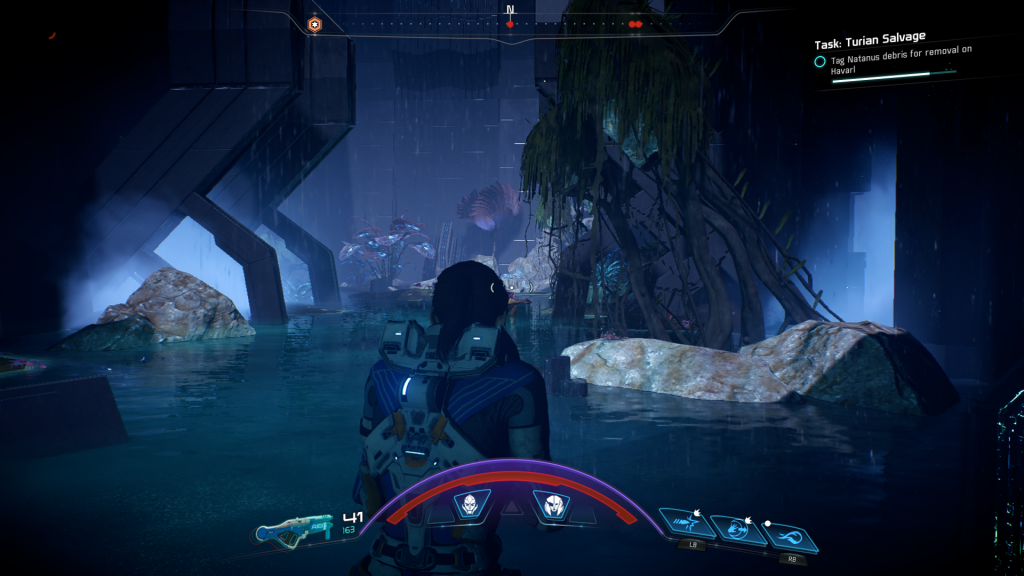
Dialogue has always been a major part of the Mass Effect series, while most choices you make won’t have any lasting impact on the greater story there are times where a single decision can make a big difference. Generally though in the previous series dialogue choices often fell into either Paragon or Renegade which often gave the same result but with different reactions. In Mass Effect Andromeda the dialogue choices fall under four types of ‘tone’; emotional, logical, casual and professional. In theory this would define how you people respond to you. But I’ve tested this and I can say that it’s more akin to saying the same thing in different ways and doesn’t really change the story at all.
Combat in this game is much more dynamic than that of the previous games, this is in most part due to the introduction of the jump jet. This jump jet allows you to easily reposition yourself or dodge enemy fire, you can even hover in place for a short period to allow you to shoot down at enemies hiding behind cover.
There are a wide range of weapons and powers to use, all of which feel great to use. The powers feel especially good when you can cause a detonation, which is when two powers hit a single target causing a chain reaction.
Something I dislike is that Bioware have removed medigel as a usable item. This makes the combat far more difficult. Sure, there are health packs scattered around but you have to find them and they run out very quickly.
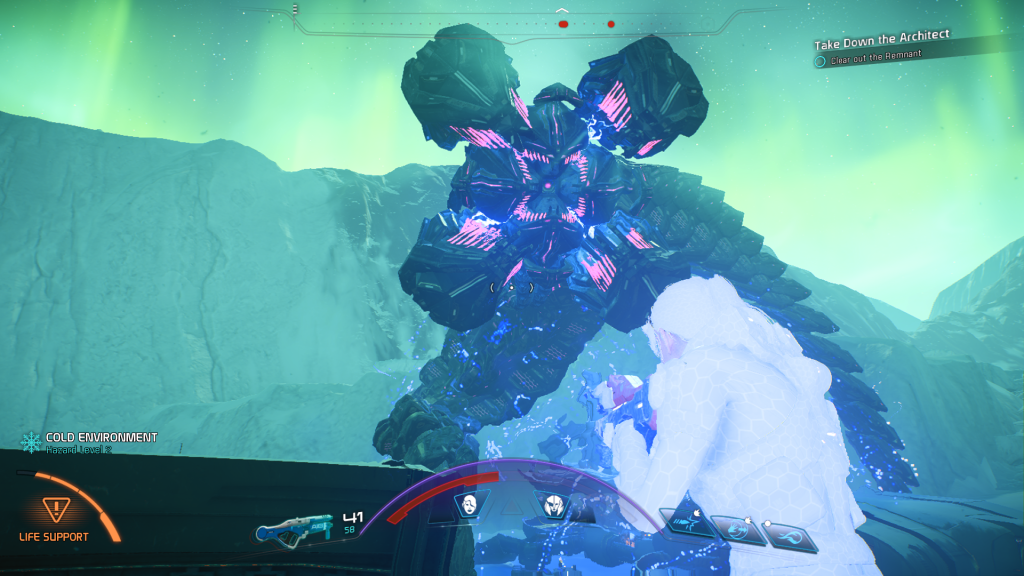
Weapons fall under one of five categories; melee, pistols, assault rifles, shotguns and sniper rifles. All of these can have modifications added to them in the loadout screen (except melee weapons) along with the augmentations that you can apply when you create them in the Research and Development terminal.
Since I just mentioned it, it’s time to cover the Research and Development terminal. The main one you’ll use in the game is aboard your ship The Tempest but others can be found around the various places you visit in the game. From this terminal you can, you guessed it, research and develop new weapons, armour, mods, augmentations etc. Research is split into three main categories; Milky Way, Heleus and Remnant. To research something you have to spend research points, specifically the research points relating to that category. Meaning you can’t research a Remnant weapon using Milky Way research points.
Once you’ve researched something you can then create it in the development screen. Developing an item costs materials with some materials being harder to find than others. You can also choose to add an augment to an item you develop, this can change the way the item functions. For example, I created a weapon that fired bullets that ricocheted when they hit a solid surface but it slightly lowered the weapons range.
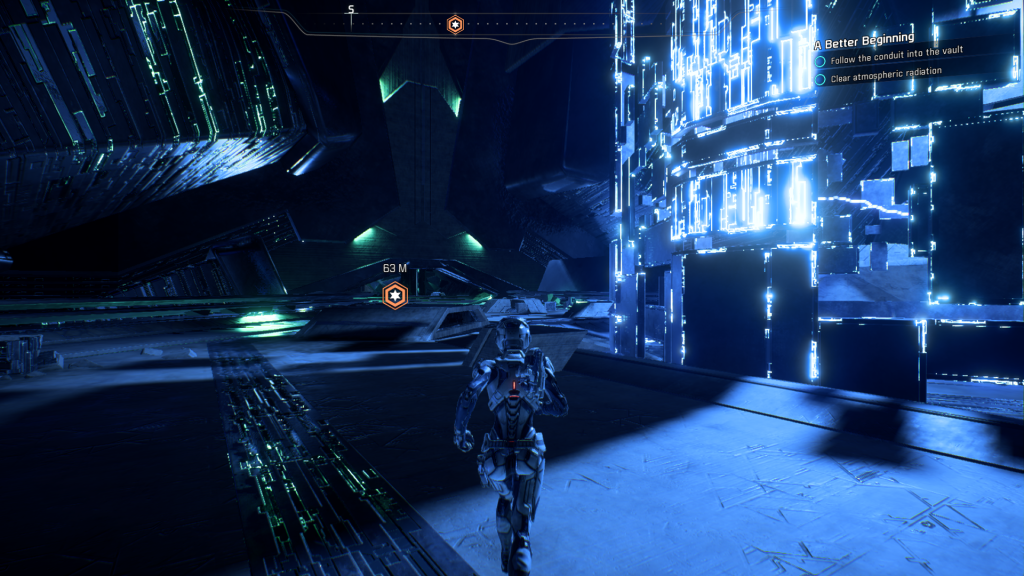
Ryder comes equipped with a scanner that they can use to gain research points by scanning unknown technology and lifeforms. The scanner is also used to great effect by assisting in multiple different missions such as finding tracking enemies, following connections to find a hidden console etc.
As with most RPG’s killing enemies and completing missions gives experience points which in turn levels you up. Each time you level you are given a certain amount of skill points to spend on improving your character. You can spend these points in one of three categories (each of which has multiple options); Combat, biotic or tech. You also gain points to spend on your companions, making them more potent.
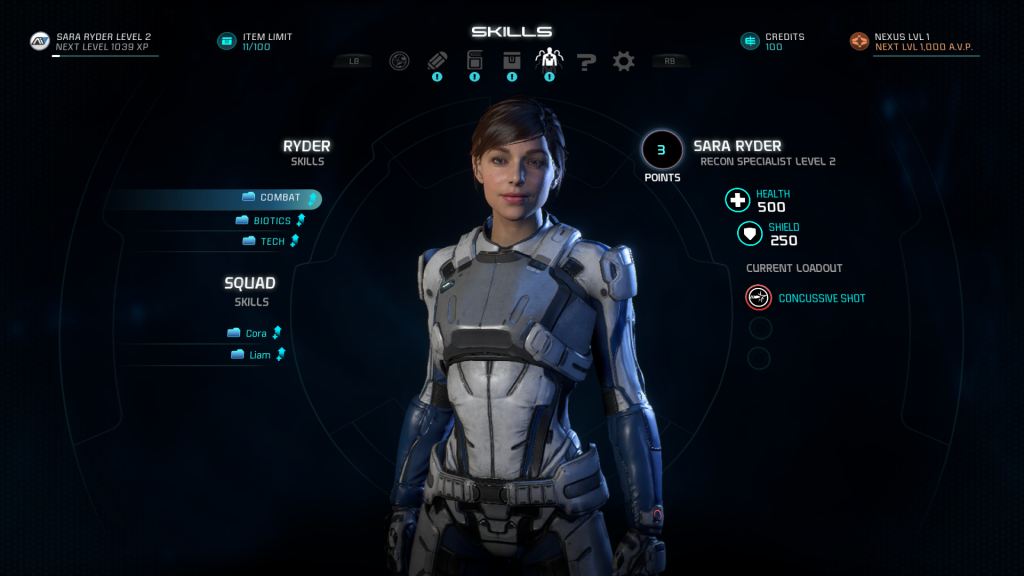
Ryder has a cybernetic neural implant that allows them to swap between ‘profiles’ thanks to an AI called SAM (Simulated Adaptive Matrix). These profiles are what replace the class system, instead of picking a single class and sticking with it Ryder can swap between them on the fly. Each of these profiles confers a passive bonus while active such as increasing weapon damage etc. There are a total of seven profiles (one for each class plus a new one called explorer) that can be loaded, however you can only have one profile active at a time and there are thresholds that must be met in order to unlock some. These thresholds are the number of skill points you invest in a specific skill group. For example, to unlock the Sentinel profile you need to spend three points each in biotic and tech skills. These profiles also have ranks that are achieved by spending more skill points in the related skill groups. Increasing the ranks of a skill increases the passive benefits that the profile comes with.
Exploring the galaxy map works similarly to Mass Effect 2 where you look at and scan planets individually in each system without having to physically pilot the ship over to it. However, traversal between planets and systems is overly animated for my liking. I don’t need such long animations to travel from one system to another or even one planet to another. At first I thought the animations were to disguise loading times and perhaps when travelling between systems it is, but the animation between the planets within a system can be skipped which shows that it isn’t hiding a loading time.
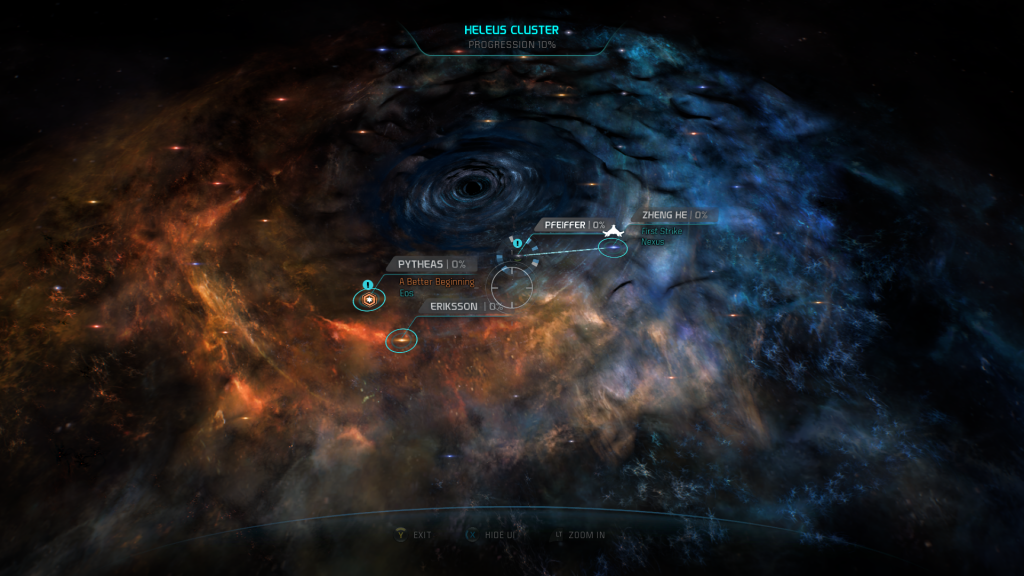
When exploring worlds in your ground vehicle (called the Nomad) you occasionally will drop ‘forward stations’ that act as fast travel points as well as a place for your Nomad to heal if it gets damaged. You can also use these forward stations to swap out your loadout or active squad mates.
Certain actions you perform on planets will increase its ‘viability’ (such as dropping forward stations). This translates into points called AVP (Andromeda Viability Points), which in turn can be spent at specific terminals to give perks that grant bonuses. Some of these bonuses are time based, such as getting certain materials that can be collected at certain time intervals and others are more passive like lowering the cost of items in stores.
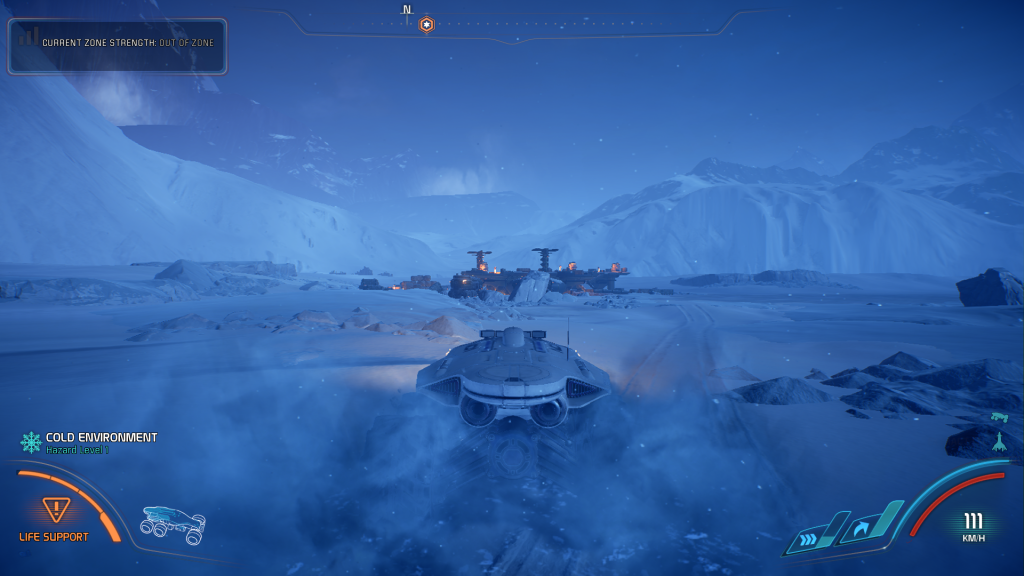
As I mentioned at the start of this review Mass Effect Andromeda originally came out with a lot of bugs and glitches. Unfortunately, despite many fixes there are still some small glitches that occur throughout the game, from npc’s facing the wrong way in conversations to character animations that suddenly snap into place. Most of these bugs are immersion breaking rather than game breaking, however, there are several bugs that can impede progress. Such as enemies that enter the geometry of the world and can shoot you while remaining completely invulnerable to damage.
There is a multiplayer that is semi integrated into the single player in the form of Strike Teams you can send out. I can’t speak to this though as it’s not something I engaged with (I don’t really do multiplayer unless my friends are involved).
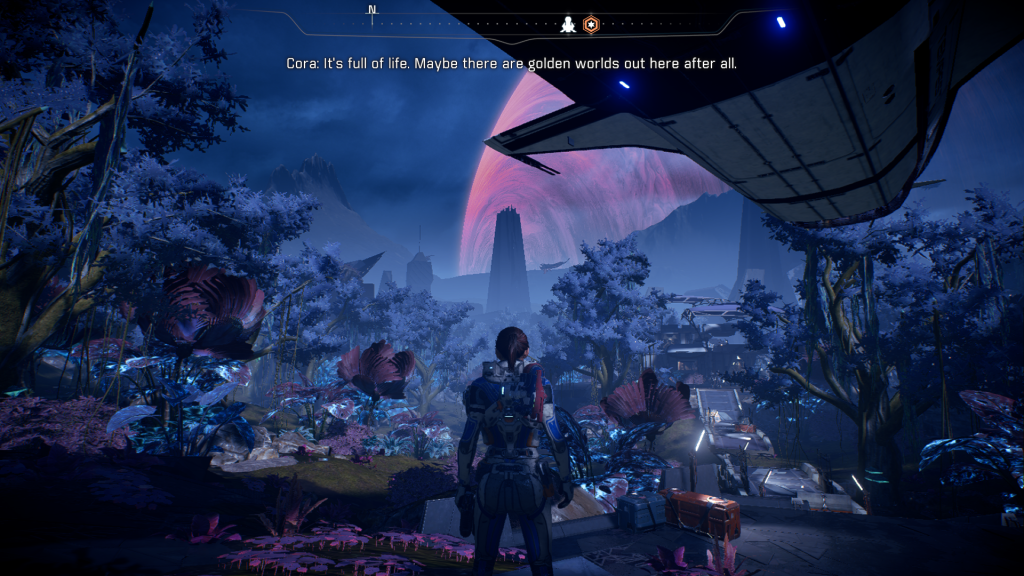
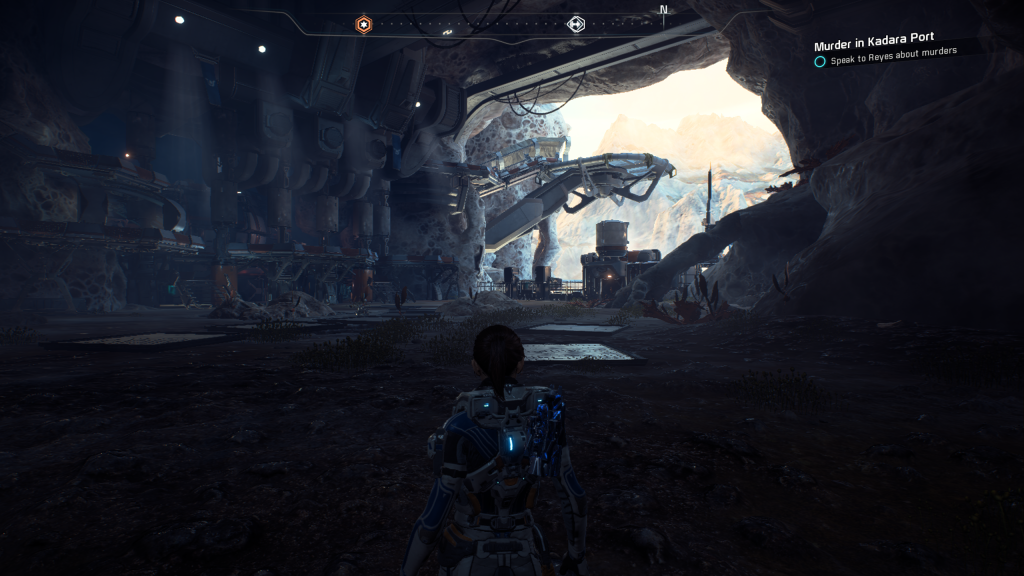
Graphically this game is very pretty, there are some gorgeous vistas on display. I’m not saying that these effects couldn’t have been achieved in the Unreal Engine, in fact I’m sure they could have been. But the Frostbite engine is shown off to great effect here.
I have to admit I’m a bit disappointed that the Codex (the in-game encyclopaedia) isn’t voiced at all (unlike the original trilogy). I used to love listening to that in the main series.
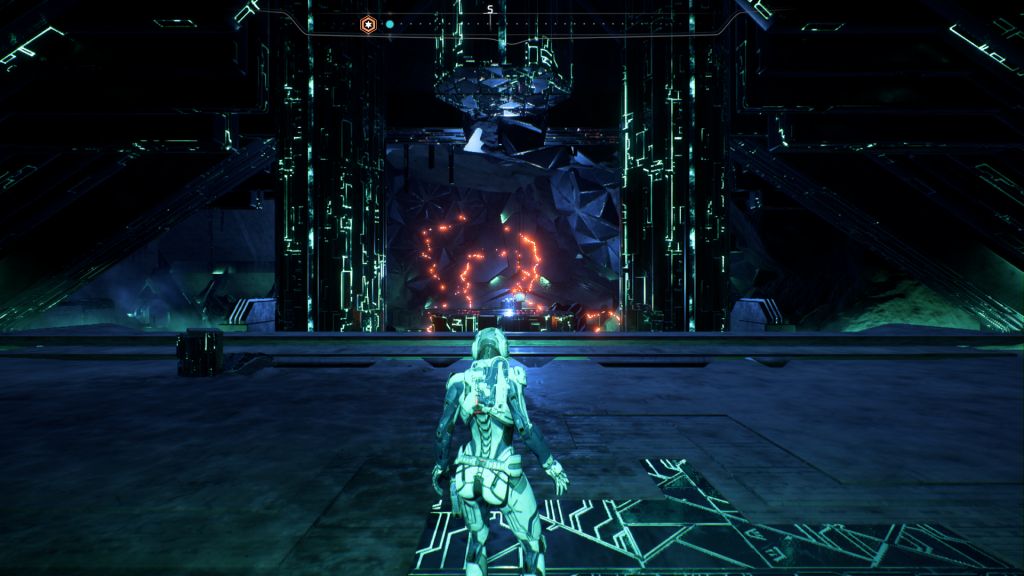
My final thoughts… This game is fine. But that’s all it is, just fine. Despite all the ire that the ending of Mass Effect 3 garnered there were few who thought of that game series as ‘fine’.
I do hope that Bioware has learned from the mistakes of this game (as well as Anthem). That being said, if there is anything that absolutely should be taken from this game and added into the next Mass Effect it should be the jump jets.
If this appeals to you perhaps try;
Mass Effect Legendary Edition
The Dragon Age Series
Star Wars: Knights of the Old Republic