Developer: Remedy Entertainment
Publisher: Epic Games Publishing
Steam Deck Compatibility?: N/A
Rrp: £39.99 (Epic)
Released: 27th October 2023
Available on: Epic
Played Using: Xbox One Control Pad
Approximate game length: 20+ hours
Warning: Explicit male nudity appears at the very start of this game along with rather detailed and gruesome murder.
I have to admit I’ve been looking forward to this game ever since I suspected there was a sequel in the works from the hints left in Control and its AWE (Altered World Event) DLC. As developers Remedy Entertainment has yet to let me down when it comes to the sheer quality of the work they put out. Now, why would I mention any of this? Won’t that mean that this review is going to be highly biased? Well.. yes, it does but it also means that this game has a lot to live up to as well. My expectations walking into this game are extremely high, so to me at least, it has a lot to prove.
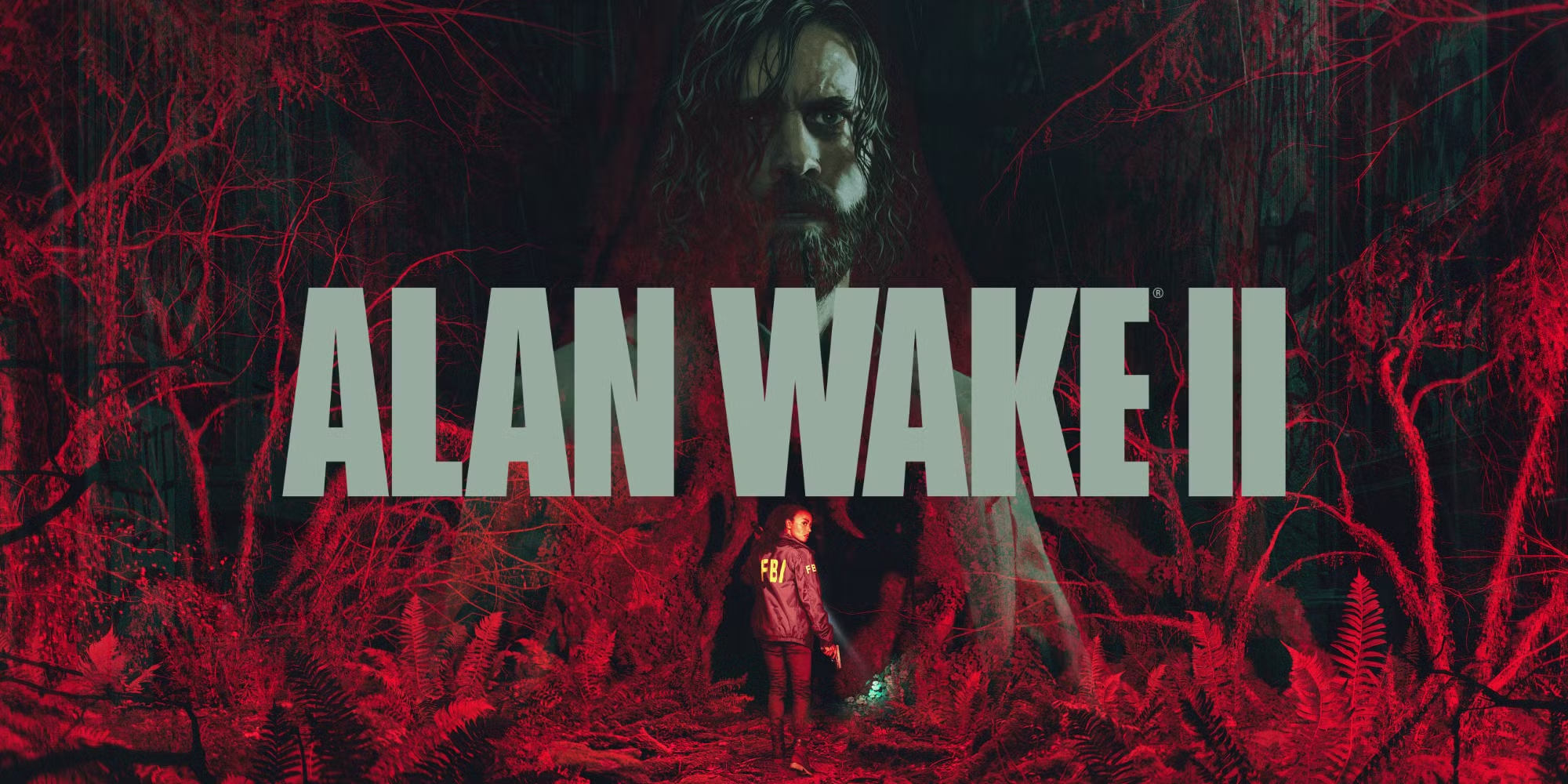
In all the previous games within the Alan Wake series (those being Alan Wake and Alan Wake’s American Nightmare) you only played as the titular Alan Wake. However, in Alan Wake 2 you play as two characters that you can switch between at break rooms (or when the game occasionally demands it), Alan Wake and Saga Anderson. Saga Anderson is an agent of the FBI who along with their partner Alex Casey has come to Bright Falls to investigate a brutal murder. As for Alan Wake, he’s a writer who is originally from New York that went missing in 2010 (the same year the original game released on Xbox 360), which in the game is thirteen years ago.

The two characters play similarly for the most part but do have some key differences, the setting itself being one major example. You see, when playing as Saga you explore Bright Falls (and surrounding areas) investigating and eventually solving the various cases that surround the overall mystery of Cauldron Lake. Alan on the other hand is trapped within The Dark Place, which on this occasion has morphed into the form of a dark and twisted area of New York City. Alan is constantly looking for a way to escape The Dark Place and in doing so will encounter many strange and horrifying events.
Saga has a mind palace which she refers to as a mind place. When you’re first introduced to the mind place it’s with the context that it’s simply a place to organise the clues that she’s gathered for whatever case she’s working on (to which you can and will work on several at once) on the case board. The mind place also allows you to profile key suspects and victims that you encounter in the game by mentally putting yourself in their shoes and asking questions. However, you can explore the room that is the mind place and interact with collectibles you’ve found on your explorations such as radio broadcasts, TV adverts and the manuscript pages you will find.
The mind place also has several little tidbits about Saga’s life and past, which makes sense really since it is set within her mind.

If I do have a small frustration with this game it’s that sometimes you can’t progress until you ‘solve’ or investigate something completely within your mind place, even if you, the player, have figured out what you need to do already. Frankly though, that’s me being nitpicky because I’m actively looking for something that annoyed me even if momentarily.
While Saga has the mind place Alan has the Writers Room. In this room Alan uses a plot board where he can influence specific areas within the Dark Place by changing what happened in that space. Doing this will open up new avenues to progress which in turn lead to more ‘plot points’ that can be used to change those locations previously mentioned. It should be noted that it’s always useful to cycle through and explore each new plot point you find at every location as they can reveal more information and resources.

I think it’s fair to say that this game is a lot more cerebral than the previous games in the series, especially when playing as Saga. You won’t always get rewarded for simply exploring but instead may have to solve a puzzle if what you find is a nursery rhyme or a cult stash.
Cult stashes are locked boxes that can be found in the various areas you explore, to unlock them you’ll have to solve a puzzle. Sometimes these puzzles are a simple rhythm game but others may have you reaching for a calculator or exploring the immediate area for hidden clues. Within these stashes is quite a lot of extra equipment, which can be immensely useful especially if you’re playing at a high difficulty level. The nursery rhymes are a different beast though. These require you to read through a short nursery rhyme and place the appropriate dolls upon the correct symbols. This means that not only do you need to work out which dolls go where but also you have to find the dolls themselves. As such, you may not be able to solve some of the nursery rhymes when you first encounter them as you may be lacking the right dolls. Once you do complete the rhyme you’ll be rewarded with a charm for the bracelet Saga wears, that is once you find where it was placed (sometimes it isn’t obvious) and you may have to fight off some Taken.
I should note that the nursery rhymes and cult stashes are only found when playing as Saga.
As I mentioned a moment ago, Saga wears a charm bracelet that you can equip up to three charms to. Each charm equipped has a different passive ability to Saga, such being less likely to get stunned when hit by a Taken or increasing the amount of resources you find in containers.

Another thing you may find when playing as Saga are Alex Casey lunch boxes that have been hidden. Within these lunch boxes are manuscript fragments that can be used to upgrade your weapons within the mind place. Now all this seems very Saga centric, and honestly it is. However, Alan isn’t left out completely, much like Saga finds manuscript pieces to upgrade her weapons Alan can find words of power to make himself more effective. To find the words of power you have to use your flashlight to spot arrows that will only appear in the light, eventually they will lead you to some words that are scrawled in a spiral, those are the words of power. Just point your flashlight at it for a moment and it will count as collected.
Alan also has equipment caches that he can find in the form of suitcases, though there aren’t any puzzles to solve for those.
When you pick up a manuscript page (that’s important to the story) you’ll hear a brief voice over by Alan Wake. This voice over gives you just the information that you need to progress, but if you then access it within the mind place you’ll be given a longer, more detailed version. I always made a point of listening to the full version myself as I appreciate the story.

The Taken make a return and this time they have a few new forms as well as some that may be familiar to those that have played Alan Wake’s American Nightmare. Just like in the previous games you need to use your flashlight to burn away the darkness that protects the Taken before you make effective shots against them. However, unlike in the previous games in the series your flashlight doesn’t recharge over time and you’ll need to keep a close eye on how many batteries you have on hand. Also unlike in the previous games, headshots do count in this game (once the darkness has been burned off).
It’s clear that Remedy have taken what they learned from combat in Control and Alan Wake’s American Nightmare and applied it here. Even small fights can feel like desperate skirmishes as you are often outnumbered.

Something else that makes a return are safe havens. There has been a slight change though because unlike in the previous games when you attack from a safe haven it becomes no longer safe for a period. Safe havens will also heal you for a small amount and the Taken can’t see or attack you when you’re in one. The most common safe haven you will find are what the game calls ‘break rooms’. These are rooms where you can save your game at a coffee thermos, store and swap objects from a shoebox and swap between Saga and Alan’s stories through a janitor’s bucket… trust me, it makes sense in the story.
Graphically this game is absolutely stunning, showing some absolutely gorgeous vistas. But the flipside of that is that the horror on display is far more detailed as well and I’m not just speaking of the gore. This game really embraces the horror aspect of the series, more so than its predecessors. Perhaps that’s because the developers have a more powerful engine to use than they originally did or maybe the creative director (Sam Lake, who also is the face of Alex Casey) really got his creative juices flowing. It could be both or more. All I can say is that it’s very effective.

I could really go into the reeds here about the meta narrative of this being a story about stories and creativity. But that would be a whole essay unto itself. The fact that such themes can and have been explored by this game without making any of it dry or boring is a testament to the sheer talent on display from Remedy Entertainment.
This game connects to the rest of the Remedyverse; that being the Alan Wake games and Control (and seemingly Quantum Break which I really need to get on) without beating you over the head with it. You don’t need to have played the previous games or Control to enjoy the story but if you have you definitely get a lot more out of it.
Once again Remedy never fails to put a set piece in that makes me not only smile but feel energised and will be stuck in my mind for years to come. In fact, they do it a couple of times in this game. They also make great use of their live action pieces, I really love the stupid TV ads that play.

Because I was playing the deluxe edition I didn’t realise I had been playing one of the DLC’s. I suppose you could say that’s a good sign as it shows that the ‘Night Springs’ DLC slots seamlessly into the game.
Once you complete the base game you can play it again in ‘Final Draft’. This is basically new game plus, except there are some narrative changes as well as some new collectibles to find. This also changes the ending of the game.
All previous (non-story) unlocks remain, such as weapon upgrades and inventory slots, but the resources don’t. Meaning the manuscript fragments you may have left over at the end of the game will be reset to zero.
If this appeals to you perhaps try;
Alan Wake
Alan Wake’s American Nightmare
Control